The Subtle Chemistry That Speaks for Life
The Subtle Chemistry That Speaks for Life
When we think about life leaving traces behind, we usually imagine fossils, bones, or maybe chemical residues. But life also leaves something subtler, a kind of atomic accent. This accent comes from the way living organisms handle isotopes, the slightly different versions of the same element.
At first glance, isotopes don’t seem like a big deal. Carbon is carbon, right? But here’s the twist: carbon can come as $^{12}C$ or $^{13}C$, nitrogen as $^{14}N$ or $^{15}N$, sulphur as $^{32}S$ or $^{34}S$. The only difference is the number of neutrons in the nucleus. That tiny difference changes the atom’s mass, and mass changes how bonds vibrate and break. Suddenly, the “same” element isn’t treated equally in chemical reactions.
Life, being opportunistic, takes advantage of this. It tends to use the lighter isotopes because they’re easier to work with — the bonds snap more easily and the reactions run faster. Over time, this preference leaves behind a measurable imbalance in isotope ratios. That imbalance is what scientists call metabolic fractionation. And the reason it’s so exciting is that it’s not random: it’s a signature of life’s activity, written into the chemistry of the planet.
From Atoms to Enzymes
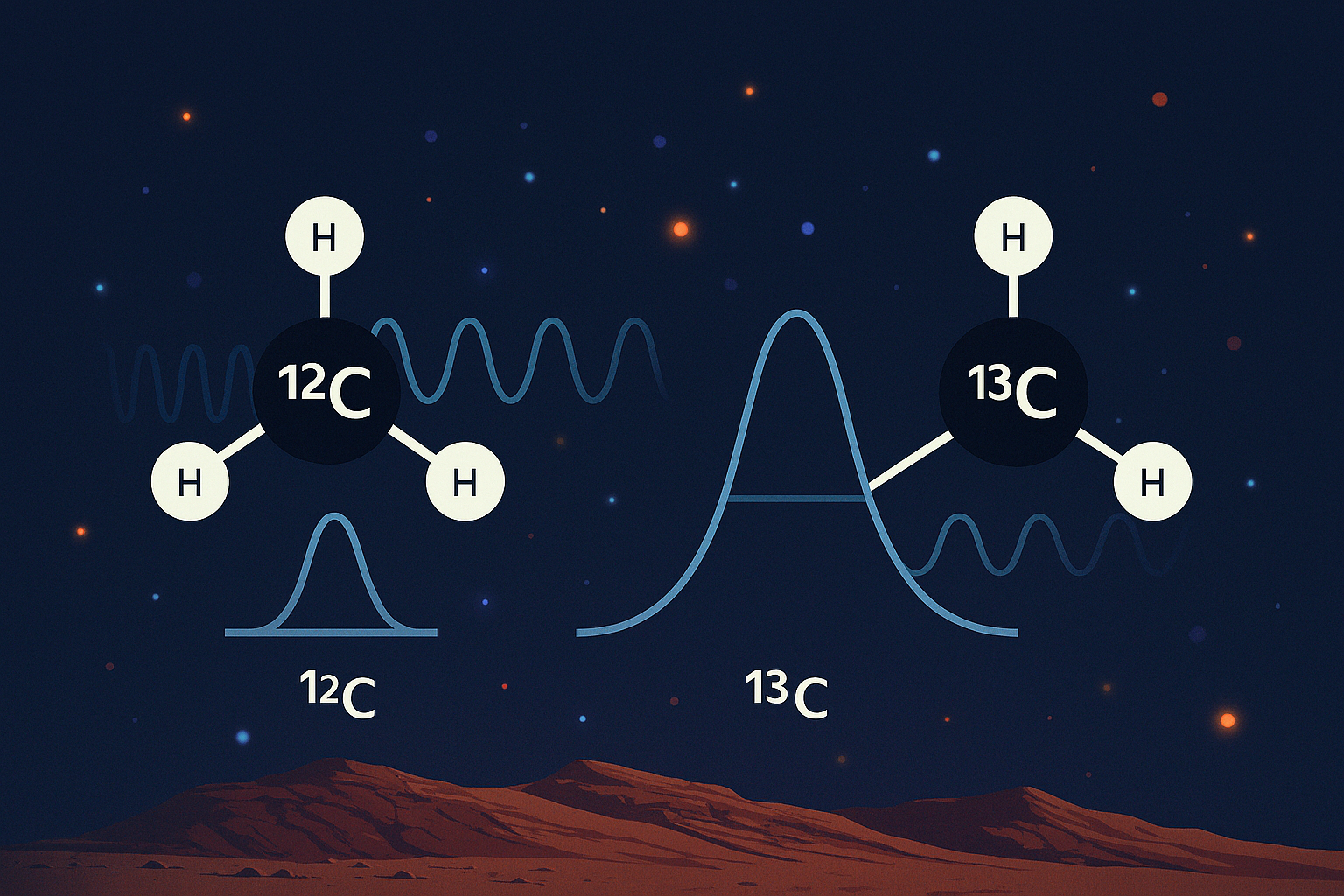
Let’s zoom in. Imagine two carbon atoms: one $^{12}C$, one $^{13}C$. Both can form a bond with hydrogen, but the $^{12}C–H$ bond vibrates a little faster, like a thinner guitar string. That vibration makes it easier to break. Now put those atoms into a living cell. Enzymes, the molecular machines that drive metabolism, are designed to speed up reactions. But they’re not neutral. They “prefer” the lighter isotope because it reacts more quickly.
So, when an enzyme has a choice, it will almost always process the $^{12}C$ molecule first. Multiply that choice by billions of reactions happening every second, and you end up with products that are systematically enriched in lighter isotopes. This is fractionation in action.
Scientists capture this difference using δ‑notation. For example, organic matter often has δ$^{13}$C values around –20‰ to –30‰ compared to inorganic carbon. That negative shift is like a chemical signature saying: life was here.
What is δ‑Notation?
When scientists talk about isotope ratios, they don’t just say “this sample has more $^{12}C$ than $^{13}C$.” Instead, they use δ‑notation (delta notation), which is a way of expressing how different a sample is compared to a standard reference. The formula looks like this:
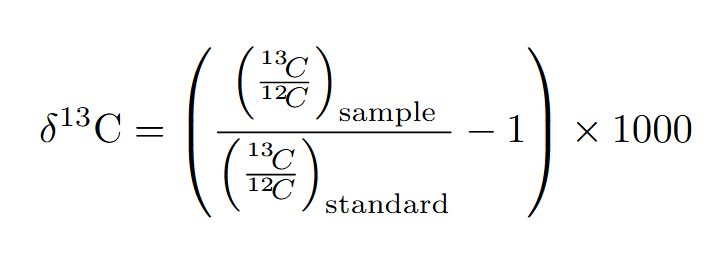
The result is given in per mil (‰), which just means “parts per thousand.” A negative δ${13}$C ≈ –25‰, that tells us it’s significantly lighter than the inorganic carbon it came from.
This system is powerful because it compresses tiny differences in isotope ratios, differences of less than 1%, into numbers that are easy to compare. Without δ‑notation, it would be almost impossible to see the biological signal hidden in the raw ratios.
How It Shows Up in Cycles
This isn’t just theory. We actually see it play out in Earth’s major biogeochemical cycles.
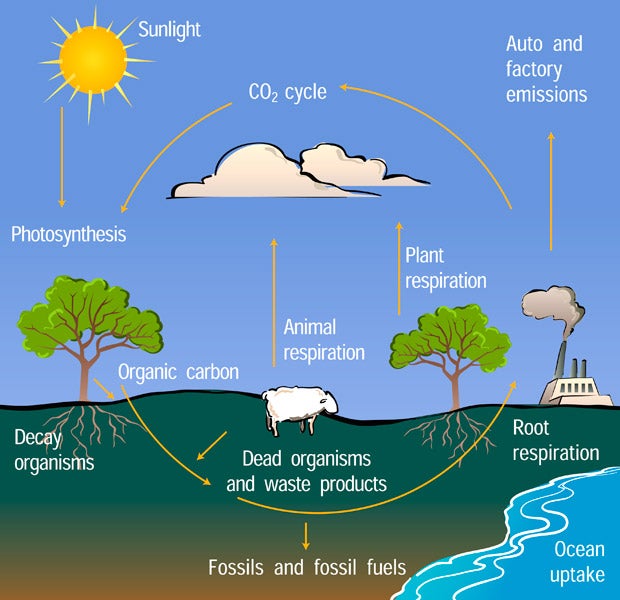
In the carbon cycle, photosynthesis is the classic case. Plants and microbes pull in CO₂, but they grab $^{12}C$ more eagerly than $^{13}C$. The sugars they make are therefore lighter in carbon isotopes. Later, when certain microbes produce methane through methanogenesis, the effect is even stronger. Methane ends up extremely depleted (having low $^{13}C/^{12}C$ ratio) in $^{13}C$, which is why methane isotopes are such a hot topic in astrobiology.
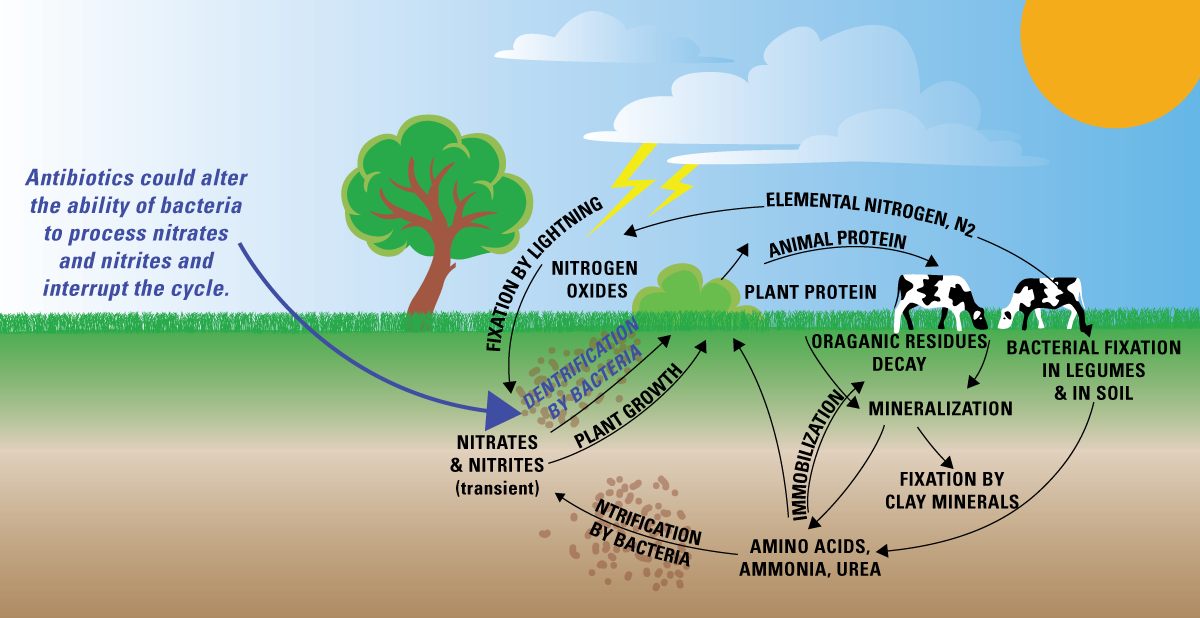
In the nitrogen cycle, microbes that fix nitrogen or reduce nitrate leave behind distinct δ$^{15}N$ signals. These signals get locked into soils and sediments, giving us a record of how nitrogen moved through ecosystems in the past.
And in the sulphur cycle, microbes that reduce sulphate to sulphide leave behind sulphide that is very depleted in $^{34}S$. This is another unmistakable biosignature, because abiotic processes rarely push sulphur isotopes that far.

Notice the continuity here: in each cycle, the same principle applies. Life prefers the lighter isotope, enzymes amplify the effect, and the result is a measurable shift in isotope ratios. Different elements, same underlying story.
Why It Matters
So why should we care about these tiny differences in neutrons? Because they scale up into something enormous.
-
They let us reconstruct Earth’s history. By measuring isotopes in ancient rocks, we can figure out what the atmosphere was like, how food webs were structured, and even how climate shifted over millions of years.
-
They let us detect invisible microbes. Even if we can’t see them, we can tell which metabolic pathways were active — photosynthesis, methanogenesis, sulphate reduction — just by reading the isotopic “accents” they left behind.
-
They give us tools for astrobiology. If we ever detect methane on Mars that’s strongly depleted in $^{13}C$, that would be a huge hint of biology. Abiotic chemistry can make methane, but it usually doesn’t fractionate isotopes in the same way.
In other words, a single neutron in an atom’s nucleus can ripple out into signals that tell us about entire ecosystems, climates, and even the possibility of life on other worlds. That’s why metabolic fractionations aren’t just a technical detail — they’re one of the most powerful ways we have to connect the smallest particles of matter to the biggest questions in science.
Sources
‘Trophic’ and ‘source’ amino acids in trophic estimation: a likely metabolic explanation by Springer Nature Carbon Cycle Diagram by UCAR Nitrogen Cycle Diagram by USGS Sulphur Cycle Diagram by Lumen