When Mixtures Reveal Their Secrets
Okay, picture this: you scoop up a handful of Martian soil. To your eyes, it’s just reddish dust. But hidden inside could be the chemical whispers of life. The problem? Those whispers are buried in a noisy crowd of other molecules. So how do scientists get them to speak up?
They use a trick that basically makes molecules run a race. Each one lines up, dashes down a pathway, and crosses the finish line at its own pace. By watching who shows up when, scientists can figure out what’s in the mix. This isn’t just a lab thing, the same setup has actually flown on spacecraft to sniff out alien soils and atmospheres.
The Principle
So how does this molecular race actually work? At its core, it’s about separating compounds based on how they move through a column. Imagine you have a mixture of molecules. They’re all vaporised and pushed forward by an inert gas, which scientists call the mobile phase. Inside the column, the walls are coated with a thin layer of material, known as the stationary phase.
Some molecules barely notice the walls and zoom straight through. Others keep stopping to stick before moving on. This constant back and forth is called partitioning. Even though the differences are tiny, over the length of the column they add up. By the time the molecules reach the end, they have spread out into neat little groups.
And here is why this is exciting. You start with what looks like a messy soup of molecules, but by the end you have a clear separation that lets you actually identify what is inside. It’s like turning static into a readable signal.
Factors that Control Separation
Now, what actually decides how fast or slow a molecule runs this race? There are three main things:
-
Volatility
Volatility is how easily something turns into vapor and stays in the gas stream. Highly volatile compounds are like sprinters. They stay in the gas and zip through fast. Less volatile ones are slower, clinging to the walls more often. On missions, this is huge. Light gases like methane or carbon dioxide fly through quickly, while heavier organics lag behind. That difference is what lets scientists tell them apart -
Polarity and interactions: If the column walls are polar, polar molecules become “stickier” and slow down. Non polar ones don’t care and breeze through. On Mars, this helps separate polar molecules like formic acid from non polar hydrocarbons. Both could be important clues in the hunt for biosignatures.
-
Column temperature: Heat gives molecules more energy, so they spend less time stuck. Scientists can keep the oven at one temperature or slowly ramp it up, which is called temperature programming. In space, this flexibility is key. One instrument has to handle everything from simple gases to chunky organics.
The cool part here is that by just adjusting these conditions, you can make invisible differences between molecules show up clearly.
Retention Time (tR)
Now that molecules are running their race, how do we keep score? That’s where retention time comes in. It’s the amount of time a molecule spends inside the column before it finally pops out at the detector. Each compound has its own “finish time” under a given setup. Compare those times to known standards, and you can figure out who’s who.
This is powerful because retention time acts like a molecular stopwatch. On Earth, it can reveal pollutants in city air. On Mars, it can show a faint methane peak. And methane is fascinating because it could come from geology or possibly even biology.
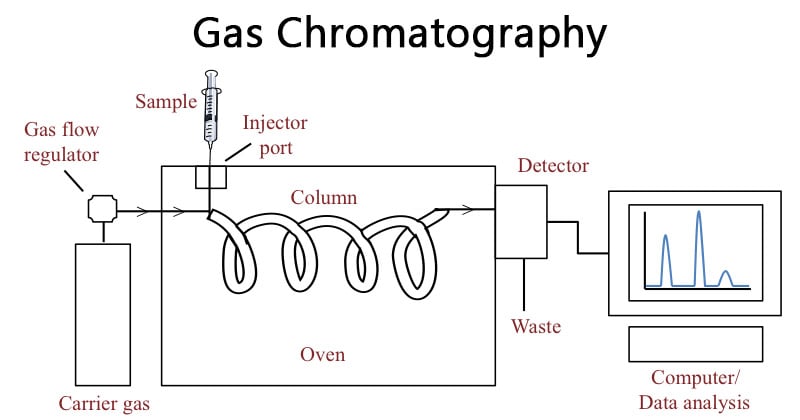
The Anatomy of a Gas Chromatograph
So what’s inside this setup that makes the magic happen?
-
Carrier Gas Supply
An inert gas (helium, nitrogen, or hydrogen) acts as the “wind” that pushes molecules forward. On Mars, for example, helium has been used to carry soil gases through the system. -
Injector Port
This is where the sample goes in. It is heated up, vaporised and mixed with the carrier gas. -
Column
A long, narrow tube coated with a special material. This is the racetrack where molecules separate. -
Oven
The column sits inside here. By carefully adjusting the heat, scientists can coax out compounds that would otherwise remain hidden. -
Detector
Sits at the finish line, waiting to measure and identify molecules as they emerge. -
Data System
Turns the detector’s signals into a chromatogram — basically a graph full of peaks. Each peak represents one compound. The taller the peak, the more of it there is.
The Detectors
So, the molecules have finished their race, but how do we actually see them? That’s where detectors come in. Think of them as different kinds of “senses” scientists can plug in at the finish line. Each one notices something different and that’s what makes them powerful.
- Flame Ionisation Detector (FID):
Burns the sample in a tiny hydrogen–air flame. Organic compounds make ions and electrons in the flame, which create a current. More carbon means a bigger signal. Super sensitive to hydrocarbons, but the sample gets destroyed.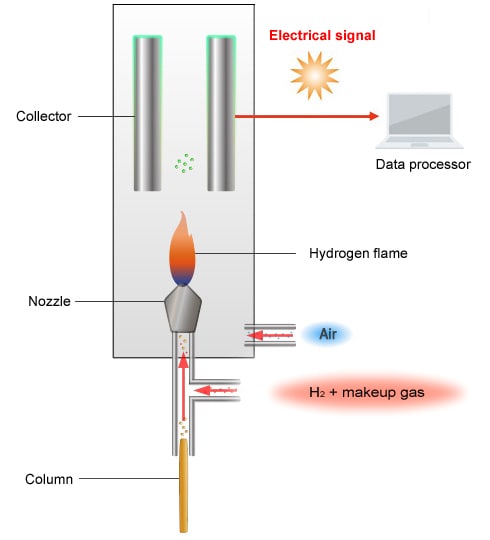
- Thermal Conductivity Detector (TCD):
Uses a heated filament to check how well the gas conducts heat. When compounds pass by, the conductivity changes. It isn’t as sensitive as FID, but it’s non‑destructive and works on a wide range of gases.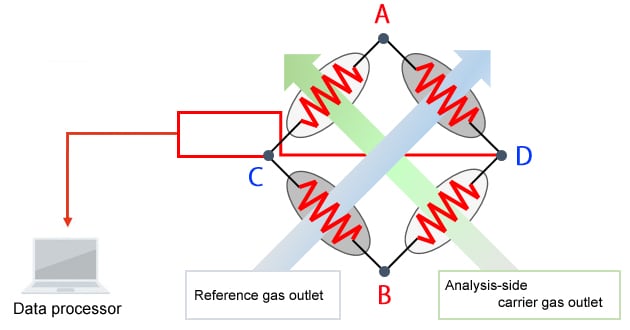
- Electron Capture Detector (ECD):
Fires out electrons from a radioactive source. Electronegative molecules (like halogenated compounds) grab some of those electrons, dropping the current. That drop is the signal. It’s crazy sensitive for those specific compounds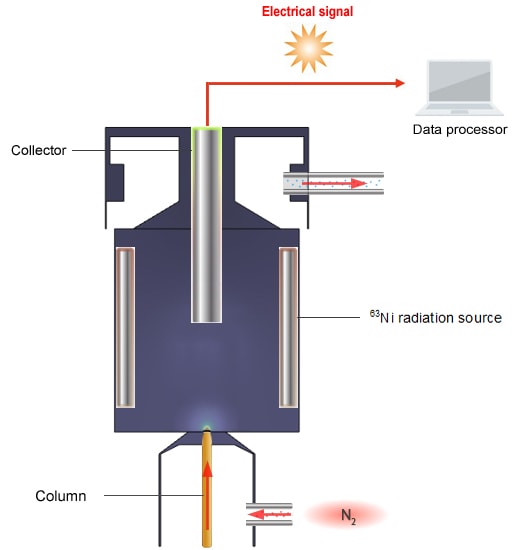
- Mass Spectrometer (MS):
The Sherlock Holmes of detectors. It ionises and fragments molecules, then sorts them by mass‑to‑charge ratio. The result is a mass spectrum — a molecular fingerprint. That’s why GC‑MS is the gold standard, both in Earth labs and on missions like Viking and Curiosity.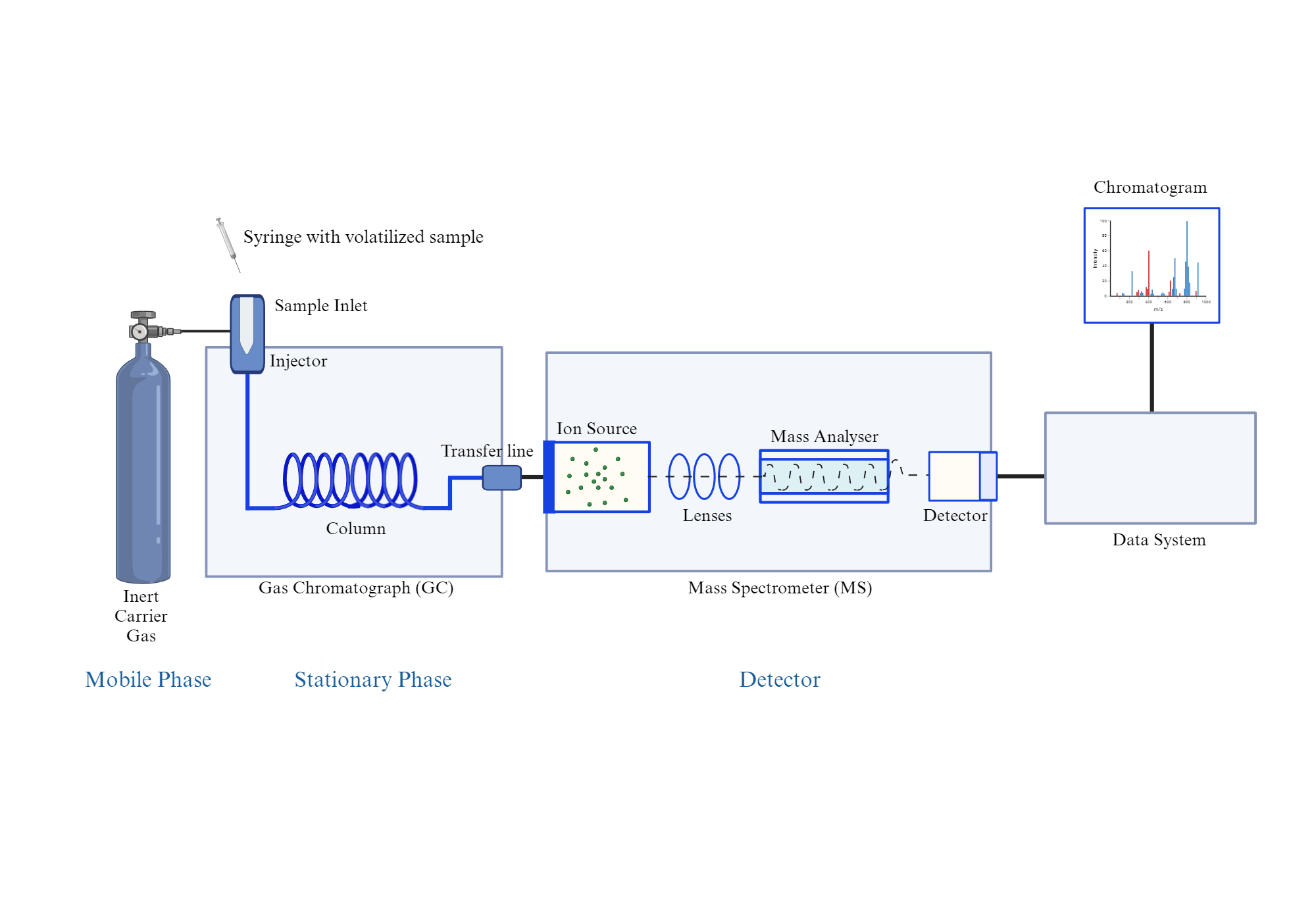
Where Gas Chromatography Shines
And here’s where it all comes together. This isn’t just a “lab trick.” It’s everywhere:
- Environmental Science: GC can track volatile organic compounds (VOCs), greenhouse gases, and pollutants in air, water and soil. For example, it’s used to monitor benzene levels in urban air or detect pesticides in groundwater.
- Forensics: In crime labs, GC helps identify drugs, toxins and even accelerants in arson cases. A single chromatogram can provide evidence that links a suspect to a crime scene.
- Food Science: From detecting adulteration in olive oil to checking for pesticide residues in fruit, GC ensures food safety and authenticity. It can even be used to profile the aroma compounds that give foods their characteristic flavors.
- Pharmaceuticals: Purity is everything in drug development. GC is used to check for residual solvents, impurities, and to confirm that formulations meet strict quality standards.
- Astrobiology:
- Viking landers in the 1970s used GC‑MS to analyze Martian soil.
- The Curiosity rover’s SAM (Sample Analysis at Mars) instrument continues this work, searching for organic molecules.
- Future missions may use similar instruments to study the icy moons of Jupiter and Saturn, where hidden oceans could harbor life.
Conclusion
So yeah — whether it’s tracking pollutants here on Earth or chasing whispers of life on Mars, this technique is like a translator between the invisible world of molecules and the big questions of science. Give molecules a pathway, let them run their race and suddenly a handful of dust or a puff of gas turns into a story about chemistry, habitability, and maybe even life beyond Earth.
And honestly? That’s the part that blows my mind every time.