Why the Universe is Turning Red
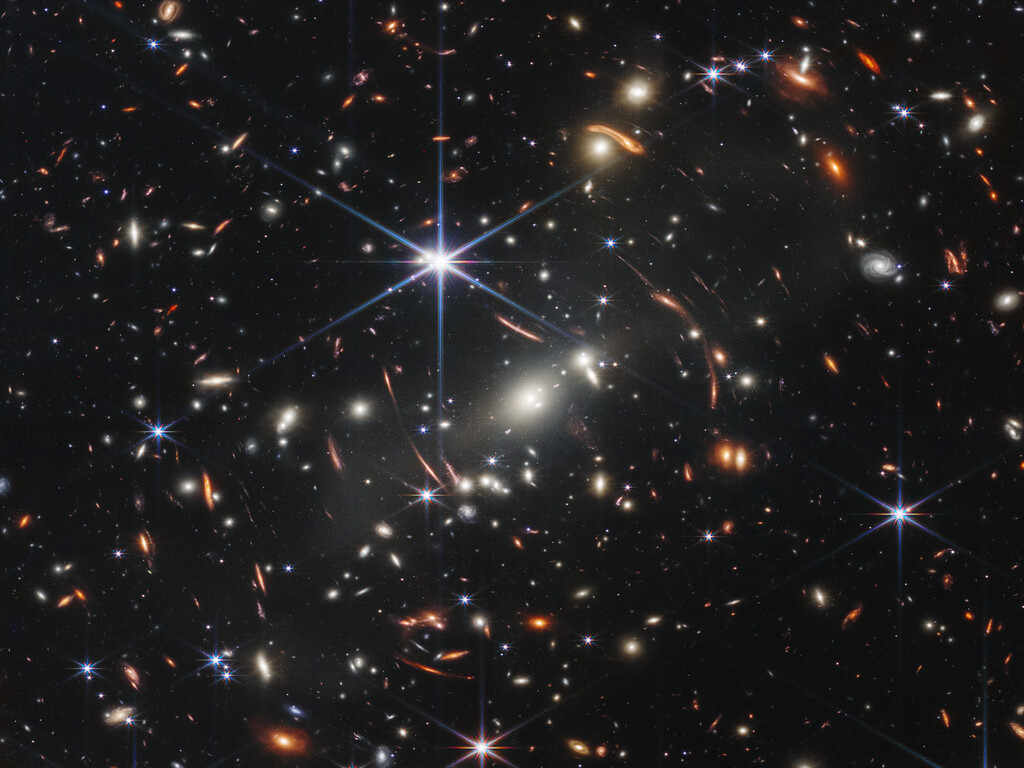
Credit: NASA, ESA, CSA, and STScI
Why the Universe is Turning Red
Astronomers face a unique challenge compared to other scientists. It’s that they cannot touch, sample, or experiment directly on their subjects. Whether it is a distant star or a swirling galaxy, the only thing astronomers have to work with is the light that travels across the void to reach us. To understand the universe, we must decode the messages hidden within that light.
To crack this code, we have to look at how light actually behaves. Much like sound moving through the air, light travels through space in waves. A helpful way to visualize this is to think about the “Doppler effect” we experience here on Earth with sound. Imagine a siren wailing on a passing ambulance. As it speeds away from you, the sound waves get stretched out, causing the pitch to drop lower.
Light behaves in a surprisingly similar way. Just as sound has a pitch, light has colour determined by the length of its waves. Blue light consists of short, tight waves, while red light is made of longer, more relaxed waves.
This brings us to the message hidden in the starlight. When an object like a star or galaxy moves away from us, the light waves it emits get stretched out by that motion, much like the receding siren. As these waves lengthen, they shift toward the longer, redder end of the electromagnetic spectrum. This phenomenon is what astronomers call redshift, and it is the primary signal that an object is receding from us.
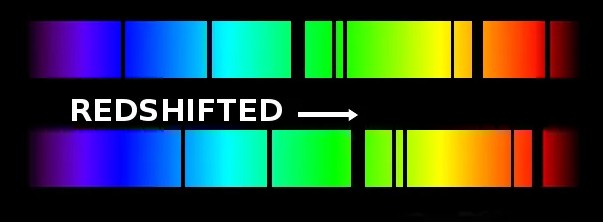
Credit: NASA
The Kinds of Redshift
While the term is thrown around often, redshift is not just a single phenomenon. It occurs for two very different reasons, and distinguishing between them is crucial for understanding the cosmos.
The first type is the familiar Doppler shift, which results from an object’s physical motion through space. This is the exact same mechanism that changes the pitch of an ambulance siren as it races past you. When a source of sound (or light) moves toward you, the waves bunch up, creating a higher pitch (or a blue color). Conversely, as the object speeds away, the waves trailing behind it get stretched out, lowering the pitch or shifting the light toward red.
This type of redshift is what astronomers use to study local traffic within our own galaxy. For instance, when we hunt for exoplanets, we are looking for the star to physically wobble back and forth, moving towards us (blueshift) and then away from us (redshift) as it orbits.
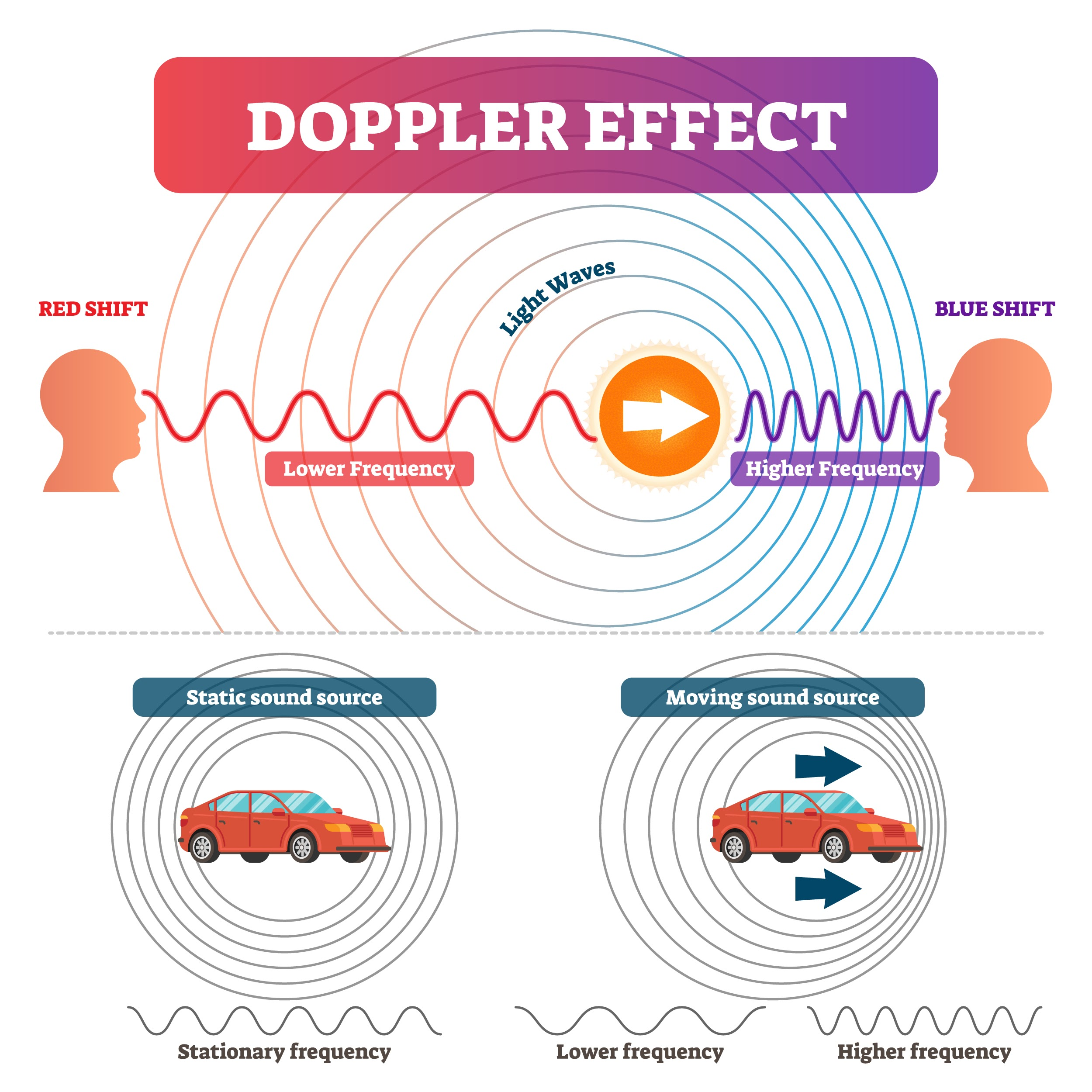
Credit: Shutterstock
The second type, cosmological redshift, is stranger and much more vast in scale. In the 1920s, Edwin Hubble discovered that galaxies are moving away from us, and remarkably, the farther away they are, the faster they appear to be receding. This recession isn’t due to the galaxies moving through space like rockets, but rather space itself expanding.
Imagine drawing a wave on a rubber band and then stretching the band. The wave gets longer, not because the ink is moving, but because the material it is sitting on is growing. Similarly, as light travels from distant galaxies to Earth, it moves through the fabric of the universe. Because the universe is expanding, the space between the galaxies stretches out.
This expansion has profound effects on how we see the early universe. Because the cosmos has been expanding for 13.8 billion years, light emitted by the very first galaxies has been stretched so dramatically that it is no longer visible to the human eye. It has shifted all the way into the infrared spectrum. This is exactly why the James Webb Space Telescope was built: to peer past visible light and see these ancient, highly redshifted galaxies. (The cover image is actually the James Webb Telescope’s first image!)
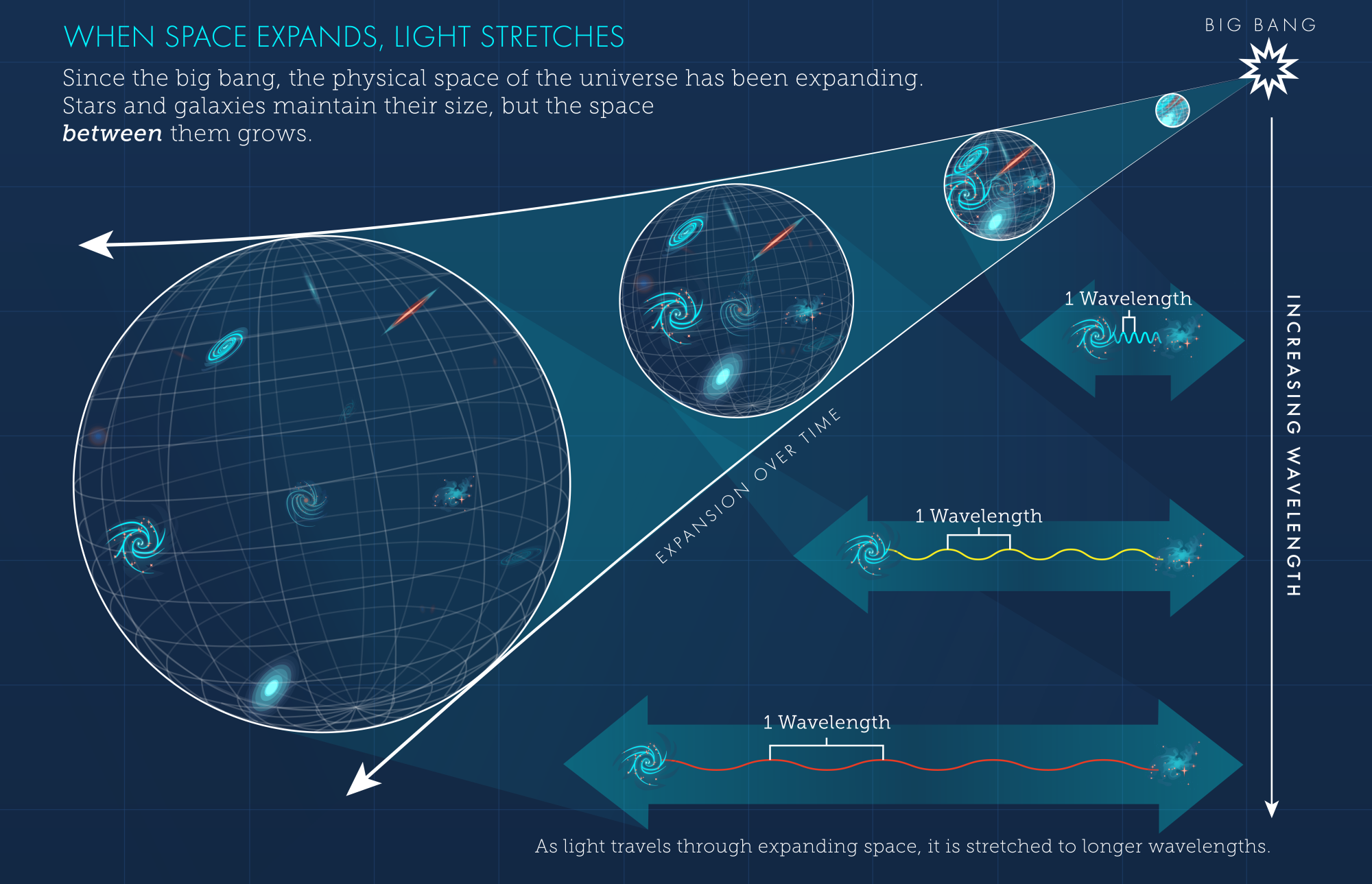
Credit: NASA, ESA, Leah Hustak (STScI)
Finding Hidden Planets
Detecting exoplanets (planets orbiting other stars) is incredibly difficult because they are often too small and dim to be seen directly against the glare of their host stars. To solve this, astronomers stop looking for the planet and start looking at the star. This method relies on a fundamental xrule of gravity. While we usually think of a star holding a planet in orbit, the planet actually exerts its own gravitational pull back on the star. The star doesn’t circle the planet since the planet is much heavier, but it doesn’t stay perfectly still either. Instead, both the star and the planet orbit a shared center of mass, known as the barycenter.
This slight “wobble” is where redshift comes into play. As the star moves in this small circle, its distance from Earth changes rhythmically. When the star’s orbit carries it away from Earth, the light waves it emits are stretched out, causing a redshift. When the orbit swings the star back toward us, the waves are compressed, causing a blueshift.
By monitoring these subtle, periodic changes in color, a technique known as the Radial Velocity method, astronomers can reconstruct the invisible planet’s orbit. The steepness of the shift tells us the planet’s mass: a giant planet like Jupiter will yank the star harder, causing a faster wobble and a more dramatic color shift than a small Earth-sized world. Meanwhile, the timing of the cycle reveals the planet’s year; if the star redshifts and blueshifts every four days, we know the planet is whipping around it in a frantic four-day orbit. This technique was the key to finding 51 Pegasi b, the first exoplanet ever discovered around a sun-like star.
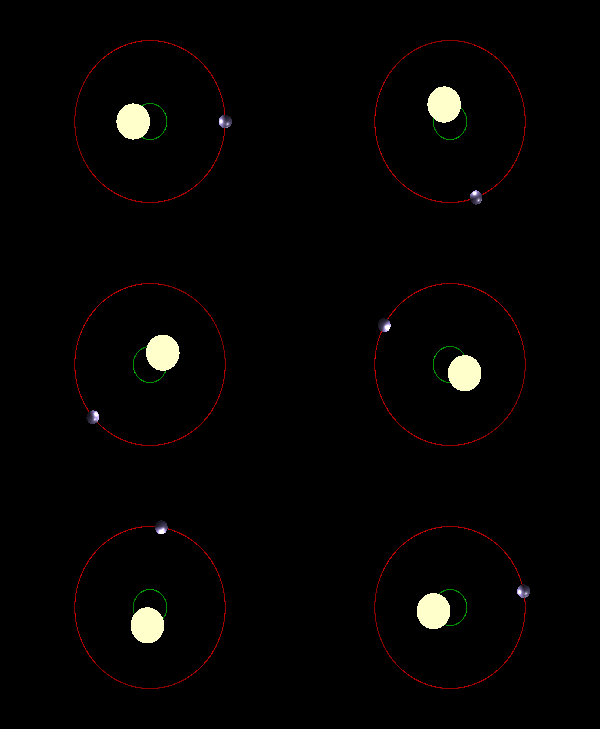
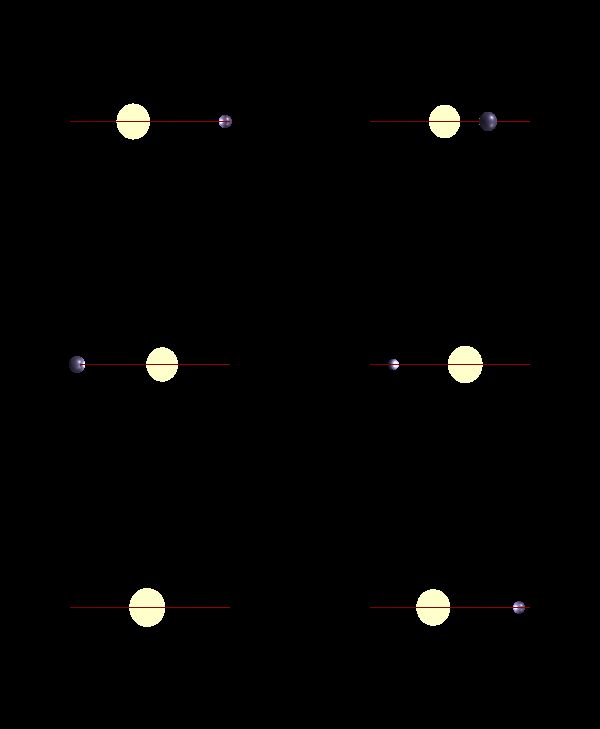
Credit: Nasa Space Place
Measuring the Universe
Why does all this matter? Ultimately, redshift acts as our cosmic tape measure. Because the faster an object moves away (or the more space has expanded), the greater the redshift, astronomers can use a measurement called “z” to calculate distance. To quantify exactly how much the light has stretched, astronomers compare the light observed from a distant object to the “rest” wavelength measured in a laboratory on Earth.
This comparison allows astronomers to calculate “z” using the formula:
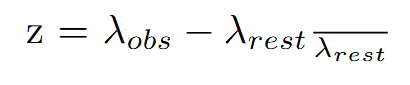
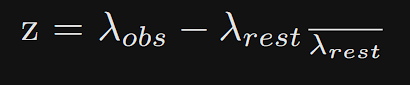
In this equation, λobs represents the wavelength actually seen through the telescope, while λrest is the wavelength the light would have if the object were stationary. If the result of this calculation is a positive number, the object is moving away (redshift), and a higher number indicates a greater shift and generally a greater distance. Conversely, if “z” is negative, the object is moving toward us, a phenomenon known as blueshift.
Before we get into the specific numbers, play with the slider below. As you drag it to stretch the wave, notice two things: the color shifts deeper into the red, and the redshift value (z) climbs higher. This is exactly what astronomers see through their telescopes.
Stretch the Light!
Redshift z: 0
This z value also functions as a time machine. Since light takes time to travel across the vastness of the universe, seeing highly redshifted objects means we are looking back into the deep past. For example, the galaxy GN-z11 has a massive redshift of z = 11.09. This specific number tells astronomers that the light from this galaxy has been stretched so much that we are seeing it as it existed just 400 million years after the Big Bang. By measuring these rates, we can even “rewind the tape” to calculate the age of the universe itself, currently estimated at 13.8 billion years.
Why It Matters
Beyond the theoretical physics, redshift is a practical tool that serves as the tape measure and clock of modern astronomy. Here is how scientists apply this concept to solve real cosmic mysteries:
-
Hunting Hidden Worlds: The radial velocity method (using Doppler shifts) is one of the most successful techniques for finding planets around other stars. It helped confirm the existence of 51 Pegasi b, the first exoplanet found orbiting a sun-like star.
-
Measuring Cosmic Distance: Cosmological redshift is the only type of redshift that gives us an indication of the distance to extragalactic objects. By calculating z, we can map the 3D structure of the universe.
-
Calculating the Age of the Universe: By measuring how fast galaxies are receding (using their redshift), astronomers can “rewind the tape” to determine when the expansion began. This allows us to estimate the age of the universe at approximately 13.8 billion years.
From the subtle wobble of a nearby star to the ancient light of galaxies stretched by the expansion of space, redshift has become the indispensable translator of the universe’s secrets. On a local scale, it allows us to detect invisible worlds by measuring gravitational tugs as small as a walking pace. By observing these tiny periodic shifts in color, we have populated our map of the galaxy with thousands of new worlds, confirming that our solar system is not unique.
On a cosmic scale, this shift is our only window into the deep past, revealing that the universe is not static but is growing every second. By reading the redshift of the most distant light, we can look back billions of years to witness the chaotic formation of the first galaxies, effectively using the expansion of space as a time machine. Ultimately, whether caused by a planet’s gravity or the stretching of the cosmos, redshift remains our most powerful tool for decoding the size, age, and history of the universe.
Sources
Color-Shifting Stars: The Radial-Velocity Method — The Planetary Society What do redshifts tell astronomers — EarthSky Cosmological Redshift — NASA Redshift — Cosmos - The SAO Encyclopedia of Astronomy What is a Barycenter — NASA Space Place